“It ain’t always easy, if your knees knock as hard as mine, but you must remember the golden rule: when the game’s going against you, stay calm – and cheat.”
Harry Flashman
I am always delighted to reunite with our morally ambiguous Victorian hero Harry Flashman, this time in Flashman at the Charge. This instalment of the Flashman Papers sees our friend unwillingly wrapped up in some of the British Army’s most famous offensive and defensive actions of the Crimean War, and of all time.
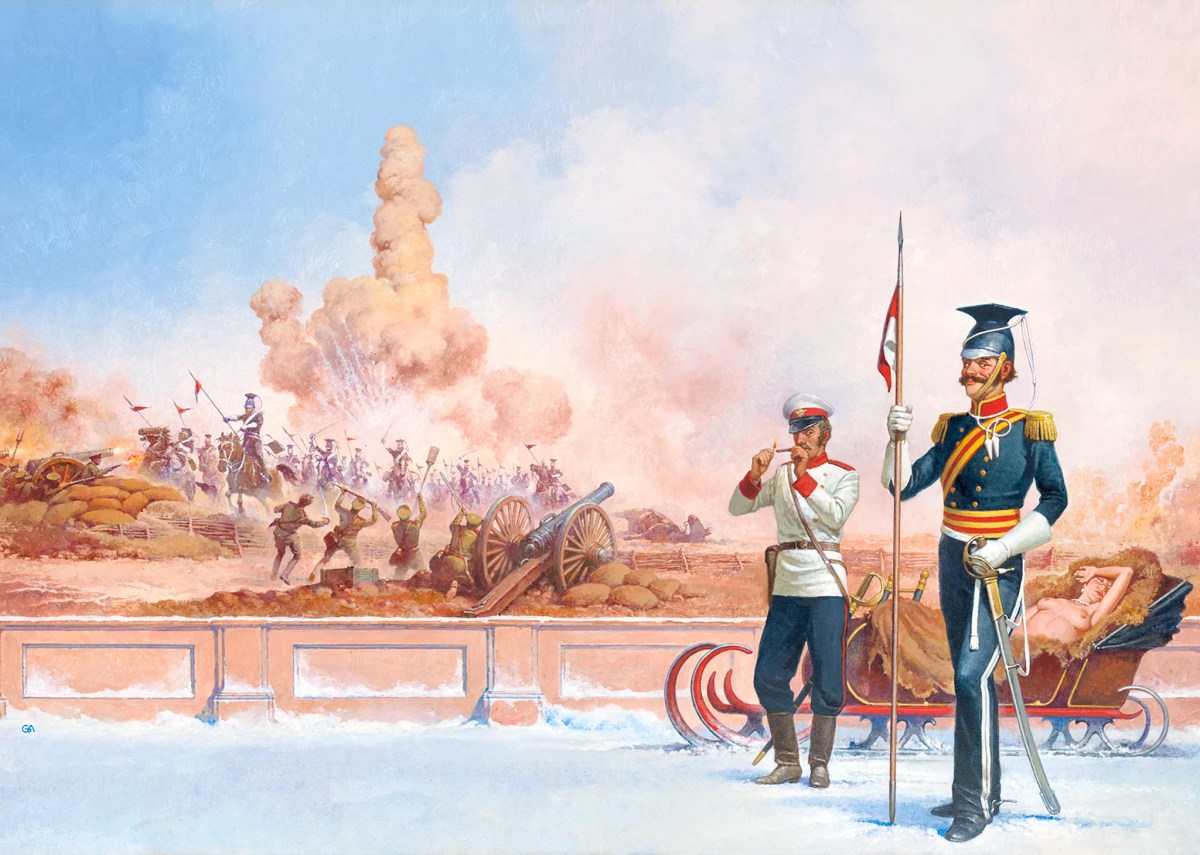
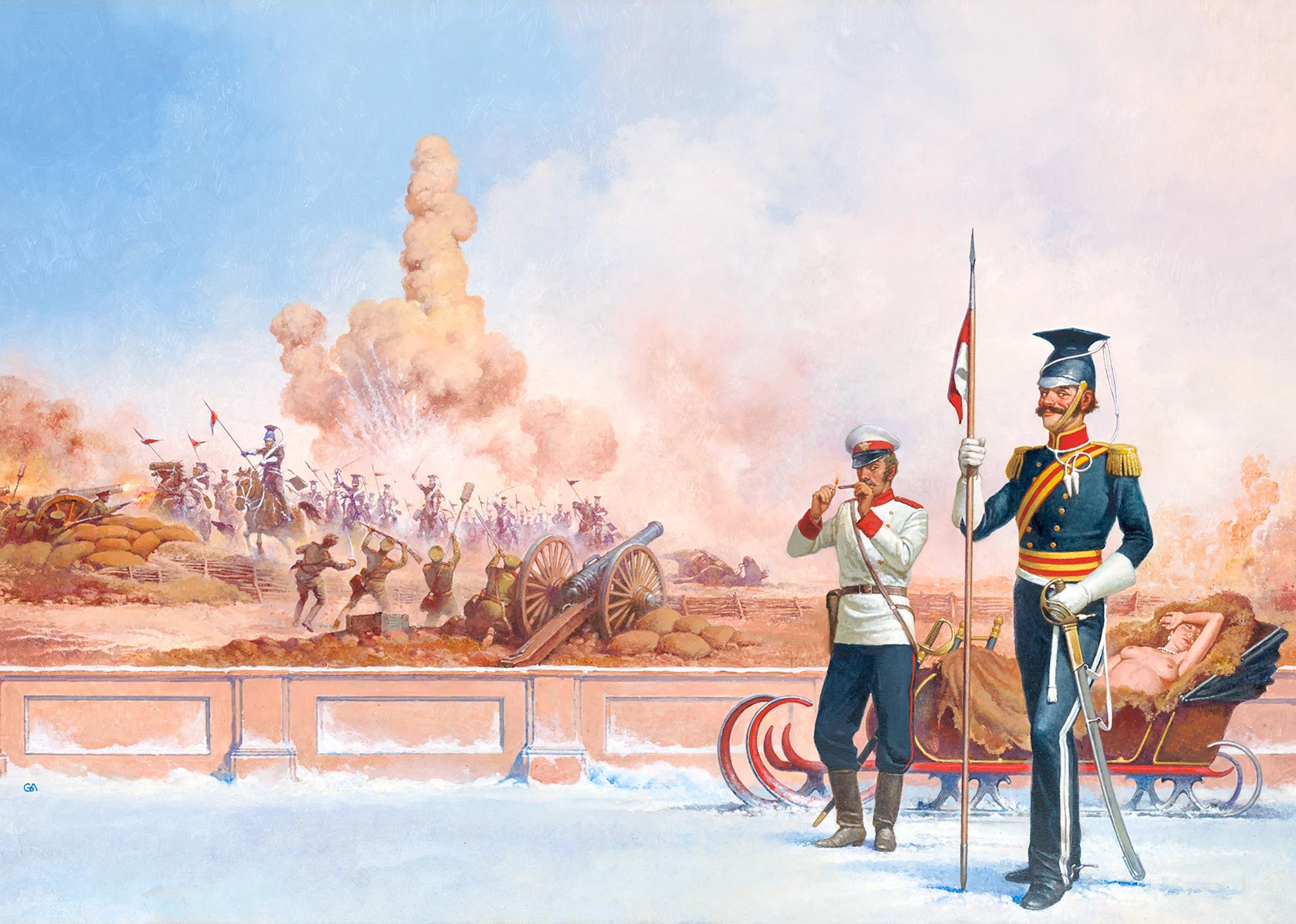
The novel opens with Harry once again enjoying a debaucherous existence in London. He unwittingly meets one of Queen Victoria’s young cousins, William of Celle, in a billiards hall, only to later on be assigned as his mentor and protector by Prince Albert, on account of his valiant reputation as a soldier (which we the reader know to be questionable). As a direct consequence of this, Harry finds himself being shipped off to the Crimean War to show young William what soldiering is all about. Despite William’s untimely death on the battlefield, Flashy is not spared from further military action. He is directly involved in The Thin Red Line, the Charge of the Heavy Brigade and the Charge of the Light Brigade. Powered only by fear and flatulence he reaches the Russian guns ahead of the other surviving chargers where he promptly surrenders and is taken to Russia.
Imprisoned comfortably in Count Pencherjevsky’s castle, he reunites with old schoolfriend Scud East who has also been taken prisoner. A failed escape attempt sees Flashy imprisoned with warrior Yakub Beg, who are both rescued by fellow Uzbek and Tajik resistance fighters. Many adventures ensue which eventually see Russian supplies being taken out by Congreve rockets and Flashman arriving safely in British India, armed with yet another heroic tale.
Like the other Flashman instalments, Flashman at the Charge is full of wit, amusing but sound societal commentary and Flashman’s unabashed desire to save his own skin by any means necessary. Flashy once again manages to manoeuvre through some of history’s key events – with a good dose of female company, drunkenness and cunning thrown in – to further cement his repuation as a brave and gallant British military hero.
As ever, I look forward to delving into the next chapter in the Flashman saga to see what one of my favourite literary characters gets up to next.
“…I take some pride in the fact that while thrones were toppling and governments melting away overnight, I was heading for home with a set of crown jewels. There’s a moral there, I think, if I could only work out what it was.”
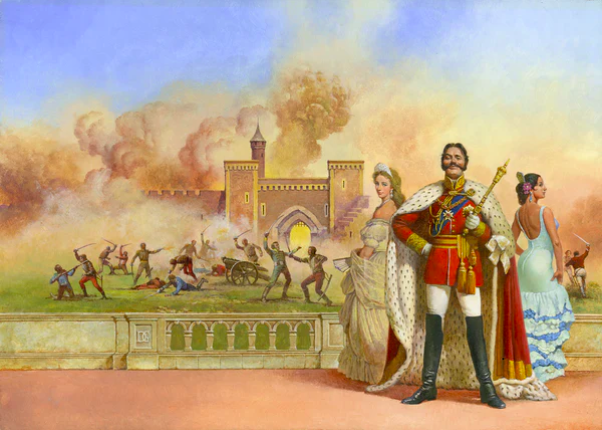
Having previously read and blogged about three Flashman novels that I had in an omnibus volume, I was delighted to revisit one of the most engaging characters in literature in another Flashman adventure, Royal Flash. This is the second novel chronologically in the series and as hoped, our hero Harry Flashman is no less roguish, scoundrelly or cunning than before.
Royal Flash has two sections which take place between 1842 – 43 and 1847 – 88. In the first section, Harry is enjoying being off military duty in London, still surfing on his heroic reputation from his escapades in Afghanistan (which readers of Flashman will know are not quite as they seem to the general public). It is here he has a dalliance with the beautiful Lola Montez and meets the dastardly Otto Von Bismarck.
It is not until section two however that Flashman comes to realise how much he regrets having met Bismarck in the first place. Unwittingly delivered to him in Germany by femme fatale Lola, Flashman needs all his cunning, seductive charm and impressive will to escape in order to extricate himself from a fiendish plot that will ultimately decide the fate of Europe. Flashman takes the reader on an exciting, amusing adventure through the dungeons and throne-rooms of Europe, engaging in swordplay, amours, disguise and deceit to escape his desperate situation and return to London.
With the risk of sounding like a broken record, the Flashman novels are magic because of the Harry Flashman character himself. A self-confessed coward and rascal keeping up the façade of a brave, respectful British Officer, in his memoirs he is unapologetically honest about his escapades and how he is always looking out for himself above all else. He is witty and refreshingly blunt to the reader, but always manages to maintain a heroic image to his unsuspecting foes. You can’t help but like him, and paradoxically he often ends up being the hero people think he is because the situations he finds himself in require courage to escape, even though like his enemies he is never averse to using underhand tactics, treachery and cunning to do so.
Royal Flash is a rollicking adventure across the continent, and once again George MacDonald Fraser has seamlessly integrated our fictional hero into real historical events with real characters, making you wish Flashy really had locked horns with the likes of Bismarck.
“I’ve been a Danish prince, a Texas slave-dealer, an Arab sheik, a Cheyenne Dog Soldier, and a Yankee navy lieutenant in my time, among other things, and none of ’em was as hard to sustain as my lifetime’s impersonation of a British officer and gentleman.”
Flashman and the Great Game
It is difficult to know how to start this blog – in a nutshell, this collection of stories is just brilliant, and has earned itself a place in my top 5 books of all time. This particular omnibus includes three of the series of novels entitled ‘The Flashman Papers’, and I’m already chomping at the bit to read the rest. The stories are the memoirs of the fictional character General Sir Harry Paget Flashman, VC, KCB, KCIE, who is slotted into a series of real historical events between 1839 to 1894.
This edition contains the very first novel, Flashman (1969), which sees the young Harry Flashman, newly expelled from Rugby School, join the 11th Dragoons. With this regiment he is reluctantly sent off to fight in the first Anglo-Afghan War, where we first discover his extraordinary ability for self-preservation through any means necessary.
In Flash for Freedom! (1971), we reconvene with Flashman in his late 20s, where we find him pressganged into crewing on slave ship the Balliol College, hiding out in New Orleans, being on the run with an escaped slave and bumping into up and coming politician Abraham Lincoln.
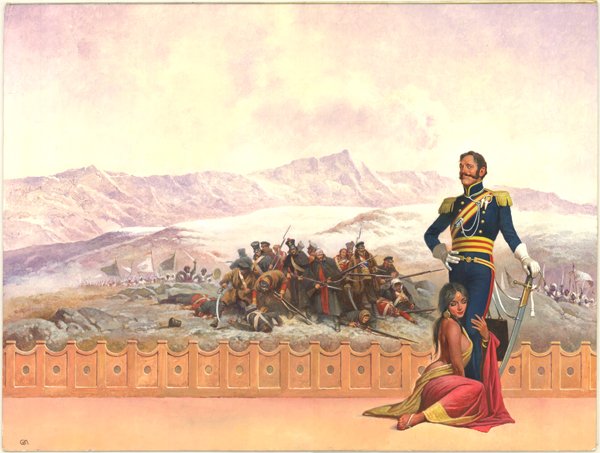
Finally, in Flashman in the Great Game (1975), we are transported across to British India, in which Flashman finds himself spying for the British government, becoming enamoured with a ruthless Maharani and getting caught up in the brutal Sepoy Rebellion of 1857.
What makes these books so brilliant is the character of Flashman himself. Up until this point it would seem obvious to assume that ‘Flashy’ is a gallant military hero. In fact, he is a self-confessed rogue, scoundrel, liar, cheat, coward and womaniser, who in every instance is just trying to save his own skin, but happens to have the charm, wit and good luck to fool those around him that he is in fact the hero he appears to be. He will happily screw over those around him in pursuit of self-preservation and is entirely truthful in what he relays to the reader. And yet he is totally and utterly likeable. His honesty is refreshing and comical to read, but also when he tells of his exploits it really does seem like he escaped each situation in the only possible way. Flashman puts it all down to his heartlessness, but in many situations it does also show him as choosing duty to his country over personal feelings towards others. Of course, he would always do whatever it takes to survive, but quite often this supposed coward does have to act with extreme courage and intelligence simply in the interest of self-preservation. By the end, Flashman has almost become the hero he says that he isn’t, in spite of himself and his actions. Furthermore, though his behaviour is audacious, completely self-centred and deplorable, he is often the voice of sanity and reason in a world full of corruption, stupidity and false piety. His wit, sarcasm and pragmatism cuts through the craziness around him which is very entertaining to read. You are guaranteed to enjoy reading how Flashman romps his way through decades of Victorian history, and how through spectacular acts of spinelessness he manages to win military glory and nationwide respect.
The character of Flashman is brought even more to life by Fraser’s unbelievably accurate replication of swaggering Victorian English, particularly when discussing his numerous exploits with various women throughout the books, which cements his reputation as a cad and a rake. In fact, Fraser’s accuracy in all elements of these books is something to be applauded. He manages to seamlessly insert Flashman and other fictional characters into real historical events without causing a ripple in the factual accuracy of the given moment. The way each battle or political event and the opinions surrounding them is relayed is so precise that you would not believe these books were written a century after they were set. On first publication, Fraser prefaced his novel with the discovery of the Flashman Papers at a house auction in Ashby, Leicestershire in 1965, and named himself only as the humble editor of the twelve instalments of the Flashman memoirs, which he called ‘packets’. He also surrounded the text with explanatory notes and scholarly additions such as maps and appendices, always using an editorial voice reminiscent of an assiduous bibliographer or archivist. Paired with the perceived accuracy and detail of the novel, almost half the initial book critics believed the Flashman novels to be real memoirs of a forgotten soldier in their reviews.
Fraser’s genius is making the historical accuracy of the Flashman stories come to life through the abounding use of comedy throughout. We have the aforementioned sarcastic, witty and outrageous voice of Flashman himself, but there is also sexual farce and intrigue, satirical dialogue and gallows humour. Fraser also expertly utilises syntax to provide humour throughout the novel, choosing just the right words to describe situations or people in an amusing manner. And yet, because he does not shy away from the awfulness, death and bloodshed encountered by Flashman and others throughout the series, the perceived reality of the memoirs remains intact. The books are undeniably entertaining and suspenseful, but the harsh historical realities of each period are illustrated truthfully. For example, Flash for Freedom! contains one of the most shocking and harrowing portrayals of the slave trade that I have ever read, while Flashman in the Great Game lays bare the horror of the Indian mutineers’ massacre of the wives and children of British military men during the Sepoy rebellion. Fraser has a knowledge of Victorian social and military history that is simply staggering for someone who is an amateur historian, and he manages to interweave this with a fictional narrative to create an astounding series of adventure, intrigue and mischief.
These books are an absolute joy to read – you will grow fond of the roguish Harry Flashman while getting a stellar education about important events of nineteenth-century history relating to the British Empire and antebellum America. In fact, you will almost be disappointed that Flashy is only fictional, as his life story really is one of the most astonishing out there.



 ImoReads