Categories
American Literature World literature

ImoReads… ‘The Goldfinch’ (2014) by Donna Tartt

Blog 39

“Caring too much for objects can destroy you. Only—if you care for a thing enough, it takes on a life of its own, doesn’t it? And isn’t the whole point of things—beautiful things—that they connect you to some larger beauty?”

I have now finished Donna Tartt’s trifecta of outstanding novels. For me, none can beat The Secret History, but The Goldfinch is still worthy of its reputation as an outstanding novel and a modern epic. It is an emotional and melancholy look into just how murky life can become after experiencing tragedy, trauma and neglect.

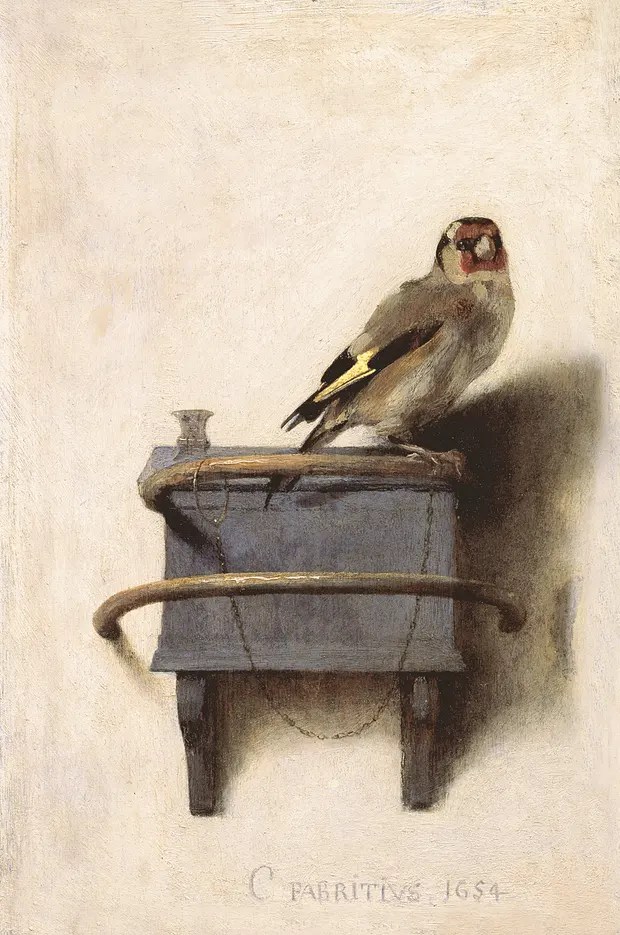
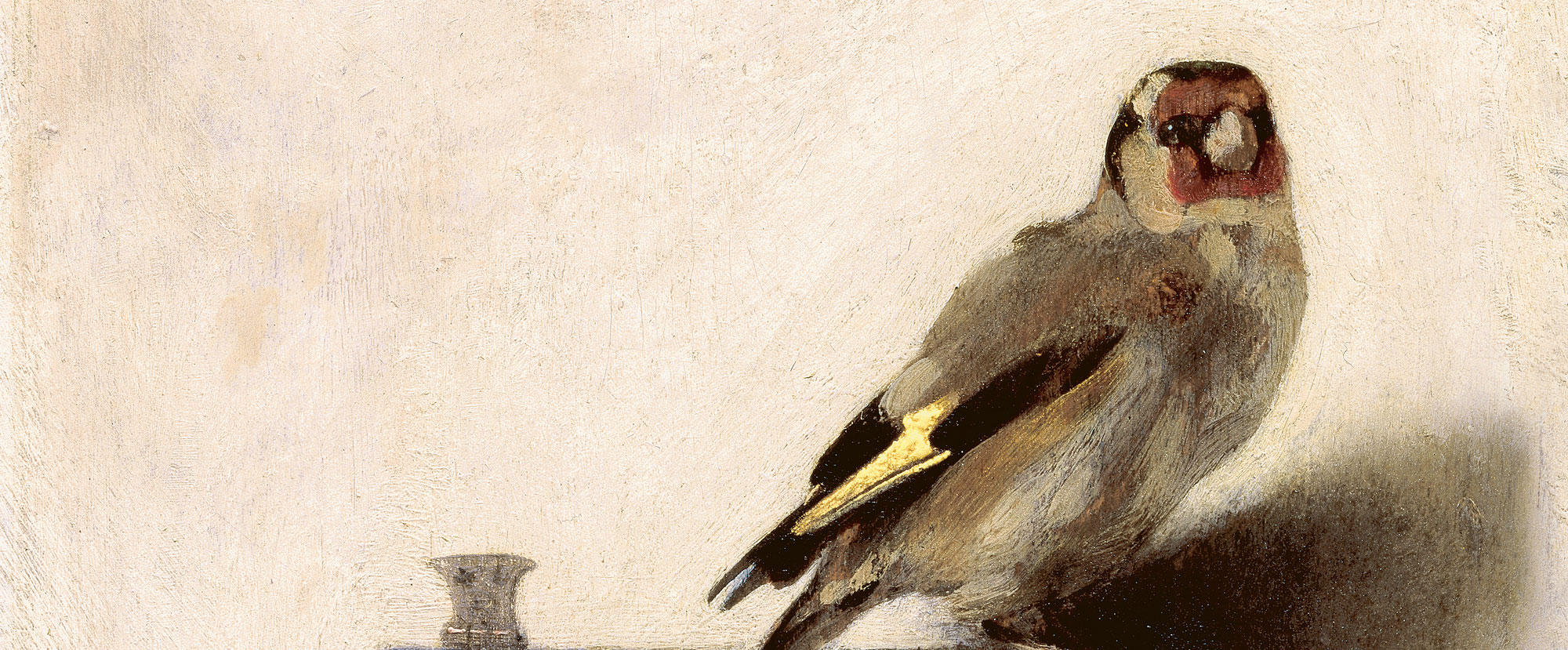
The Goldfinch opens in New York City on thirteen-year-old Theodore Decker, the son of a devoted mother and an absent father. One unfortunate day, Theo’s life is ripped apart when his mother is killed in a terrorist explosion while they are visiting Metropolitan Museum of Art together. Utterly alone and longing for his mother, he is taken in by the family of a wealthy friend, before being shipped off to Las Vegas to live with his father and his girlfriend. Traumatised by the loss of his mother, he holds dear something that reminds him of her, their favourite painting from the Met, The Goldfinch. Known only to Theo is that he has the original 1654 painting by Dutch artist Fabritius in his possession, which he took from the gallery in the wake of the explosion. Faced with neglect and indifference in Las Vegas, Theo finds solace in his friend Boris and in their descent into drugs and alcohol. Ultimately, in adulthood the painting draws him back to New York to revive old acquaintances and slowly drives him into the criminal underworld.

For me, one of the most poignant sections of The Goldfinch is Theo’s time as a young teenager in a Las Vegas suburb. Comprising of soulless new-build homes cut off from the city, most of which are empty or crumbling and some of which have even reclaimed by the Nevada desert, it feels like a metaphor for the failed American Dream. This becomes even more evident when we witness how neither Theo nor Boris have anyone in the world who cares about them, despite the fact that they both live with a parent. They often go hungry because nobody thinks to feed them and they resort to stealing. Theo’s situation at home improves only when his father’s gambling habits are going well. Both affected by trauma and with nothing to do and nobody to wonder about them, Theo and Boris are in and out of school, and spend their evenings getting drunk and high on whatever drug they can find. It is quite shocking to read about such young teenagers drinking until they’re sick or taking acid with no parental awareness or care for what they’re doing. Theo narrates this portion of his life in such a lucid and resigned way that it feels like he has accepted the fact that one tragic incident knocked him into a different life, one that is consumed by loneliness, substance abuse and monotony. 

Like Tartt’s other two novels, the research and attention to detail are remarkable. The Goldfinch allows a rare glimpse into the world of art and antiques, and the murky underworld that accompanies them. As an adult Theo has learnt the antiques trade, including how to restore pieces falling to ruin. He works in New York with Hobie, the business partner of a man who spent his last minutes with Theo in the aftermath of the explosion. Every choice and every relationship Theo has comes back to the incident and the taking of the Goldfinch painting. Twists and turns, his continued reliance on drugs and his guardianship of the painting eventually brings him back in touch with old friends from the city and Boris, and reluctantly pulls him into the greedy world of criminal art fraud and theft which leads to a page-turning bid for escape. The Goldfinch has many elements of a Shakespearean tragedy set against a modern and truly American backdrop.

Overall, The Goldfinch is an extraordinary novel that opens up a world that most of us know little about. Through watching Theo’s life and how young he experiences darker elements of adulthood, it is hard not to think that he is just a boy trying to muddle through after the devastating loss of his mother.

Happy reading,

Imo x
Categories
American Literature

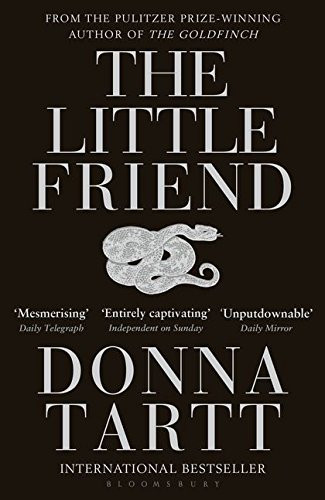
ImoReads… ‘The Little Friend’ (2002) by Donna Tartt

Blog 15

“She was young still, and the chains had not yet grown tight around her ankles…Whatever was to be done, she would do it.” 

Ever since reading Donna Tartt’s beguiling and thrilling first novel The Secret History (1992 – blog coming soon!) a couple of years back, I knew that she was a literary force to be reckoned with. So, when I came to read her sophomore novel The Little Friend, published ten years later, I expected great things; I can safely say that it didn’t disappoint. Tartt has only published three novels thus far, the third being the Pulitzer prize-winning The Goldfinch (2014) that I have yet to read. However, I think we can all agree that if it takes a decade to craft each work, then we are dealing with fiction that is incredibly well-researched, intensely vibrant and detailed, with impressively complex plots and characters (meaning this is another long blog – sorry!)

Plot

Although famously elusive about her private life, we do know that Donna Tartt grew up in Greenwood, Mississippi, a town known for its thriving cotton plantation culture in the nineteenth century. The Little Friend is set in the fictional Mississippi town of Alexandria in the late 1970s, but I imagine that many of the cultural references are reminiscent of her own upbringing in Greenwood.

The story centres on twelve-year-old Harriet Cleve Dufresnes over one school summer holidays. Harriet is quick-witted, engaging, persuasive, a total bookworm and certainly has an intelligence beyond her years. When she was just a baby, her nine-year-old brother Robin (who was the unquestionable darling of the family) was found hanged in the backyard in broad daylight on Mother’s Day. This haunting crime, told to us in the prologue, has never been solved and has left irrevocable tears in the fabric of the family.

Harriet, who has grown up in the aftermath of this tragedy, takes it upon herself to solve the mystery of her brother’s murder this one summer, and for this task she enlists the help of her friend eleven-year-old Hely; he is so hopelessly devoted to Harriet that she knows he will do whatever she says. However, what starts as a childish mission soon turns menacing and dark as they dig deeper into the mystery.

Race relations

Anyone who has read my blog on Gone With The Wind will know that novels set in the American Deep South are of great historical interest to me. The time period of the book is never explicitly stated – and it took me a while to work out that it is in fact set in the late 70s. This is because in terms of the race relations between black and white characters, it could easily have been set in Scarlett O’Hara’s time of nearly one hundred years earlier. 

That is, Harriet is from an ‘old money’ white family, and many references are made to their Civil War-era ancestral home, a now destroyed house named Tribulation. Like all the other respectable white families in town, the Dufresnes live in a big house and employ a black housemaid and gardener. 

In her childish innocence Harriet adores the family housemaid Ida Rhew more than her own mother, and yet will refer to the ‘black’ neighbourhood as ‘niggertown’ as she has heard other adults do, without realising the racism in what she is saying. 

Throughout the novel it becomes obvious that there has been no upward mobility for the black population of Alexandria. They are employed in menial jobs only, they live in the poorer end of town and they are still viewed with contempt and irrational suspicion by many of the white adult characters, even those who are the most ‘reasonable’. In fact, it was only cultural references to certain television shows, car models and current affairs that allowed me to place the novel in the late 1970s. This novel is an unnerving indication of how deep-set and rigid casual racism and attitudes of white superiority still are in the Deep South.

Narrative voices

The Little Friend is told from the perspectives of two characters – Harriet and her main murder suspect, a poor white man named Danny Ratliff who was a classmate and friend of Robin. Now a young man, Danny is a methamphetamine dealer and addict who just wants to escape his destructive family and start over. The Ratliffs are notorious in Alexandria; Danny and his brothers have all served time for various offences, and they live in a state of poverty and depravity in a trailer outside of town. 

It becomes obvious to the reader pretty quickly that Danny is unlikely to be Robin’s killer and is in many ways a victim of the American class system (which places poor whites at the very bottom of the hierarchy), but Harriet and Hely become convinced it was him due to the subconscious effect of the town’s prejudice towards the Ratliffs, and years-old rumours that Danny had bragged about committing the murder.

The excellence of this novel is that Tartt can observe with the skewed lucidity of a child – and that of a drug addict – to give a stark view of the world as unforgiving, scary, bleak and inconclusive, filtered through the bright colours and impossible clarity of childhood assumptions and drug highs. 

As The Little Friend progresses, Harriet and Hely’s attempts to flush out Danny become more and more daring as their misplaced fear of him intensifies, while Danny becomes more and more tormented by the mysterious little girl plaguing his existence. 

Genre

Although at its heart The Little Friend is a crime novel, it also fits well within the genre of adventure fiction as that is how Harriet and Hely perceive the whole escapade. There is peril, excitement and a series of events that are completely out of the ordinary in these children’s daily lives – all tropes of the adventure genre. We discover early on that Harriet has a keenness for adventure; multiple times throughout the novel she can be found reading about/referring to/imagining famed British explorer Robert Falcon Scott who led two expeditions to the Antarctic, included the ill-fated Terra Nova voyage.

Tartt’s merging of genres creates a fast-paced, tense, exciting and at times humorous story which may not have been the case if the protagonist had been an adult lacking the imagination, creativity and enthusiasm possessed by children like Harriet and Hely.

The intense detail in the settings, descriptive passages and the many sub-plots which I have not had space to mention here are a credit to Tartt and her ability to impeccably weave together seemingly unrelated details into a crucial plot point.

I won’t reveal what happens in the nail-biting finale, but what I will say is that this tale has a strong message about morality, conscience and guilt which will leave you thinking about it long after finishing reading.

For me The Secret History still has the edge, but The Little Friend is still an excellent follow up which is completely unputdownable. Next, The Goldfinch

Happy reading,

Imo x