Categories
American Literature Antiquity World literature

ImoReads… ‘The Song of Achilles’ (2011) by Madeline Miller

Blog Nº 30

“I could recognize him by touch alone, by smell; I would know him blind, by the way his breaths came and his feet struck the earth. I would know him in death, at the end of the world.”

I have wanted to read The Song of Achilles ever since being blown away by another of Miller’s novels, Circe. Much like how Circe is an imaginative homage to the goddess encountered by Odysseus in Homer’s The OdysseyThe Song of Achilles is an original take on The Iliad, one of the best known stories in the West. The heroes and villains of the Trojan War are brought to life like never before in this story of love, friendship, power and violence.

The Song of Achilles is narrated by Patroclus, an awkward young prince living in the age of Greek heroes. Exiled to the court of King Peleus on the small island of Pthia, he strikes up an unlikely friendship with Peleus’ son, the golden boy Achilles. As the two boys become young men, their bond develops into something deeper, despite the displeasure of Achilles’ mother, the sea goddess Thetis. Over the years, their companionship grows stronger and the two boys are still enjoying their carefree youth when Helen of Sparta gets kidnapped. This turn of events means that Achilles must go to fight a war in distant Troy to fulfil his destiny. Torn between love and fear for Achilles, Patroclus goes with him. 

The relationship between Achilles and Patroclus is highly significant in all stories relating to the Trojan War. In The Iliad Homer describes their relationship as deep and meaningful but never says explicitly that it is a sexual relationship. However, they were represented as lovers in Greek literature during the archaic and classical periods and it has been debated and contested ever since. Strong bonds between men was a custom in Ancient Greece, and this relationship could be intellectual, political and sometimes sexual. Miller has chosen to make their relationship deep and meaningful on many levels including sexual, and as such has created a moving, heartbreaking story.

As Patroclus narrates the novel, we are aware of his awe and admiration for the beautiful Achilles from the moment he arrives in Pthia. After several stolen glances and chance encounters, the pair finally speak, and a tentative friendship begins. In fact, they are good friends for a long time before anything else develops between them, though it’s clear they both desire each other. Miller’s smooth prose conveys their relationship as sexy and intense as well as thoughtful and sensitive, making the reader extremely emotionally invested in their bond, particularly as the danger of war looms.

Miller spent ten years researching and writing this book but has succeeded in crafting a seemingly effortless narrative that takes all the key elements of The Iliad and other stories to create a highly affecting version of Achilles. Where once stood the callous, cold superhero is now a man with depth who can be kind as well as godlike. He is not just a hero but a lover, a friend, a son, a father, a husband and most importantly, a normal human being. This makes the reader all the more emotionally engaged in the relationship between Achilles and Patroclus, because it is clear they are the only people for each other. 

The Song of Achilles is an epic novel, with several years passing before the ten year long Trojan War. I enjoy epic novels because you really become invested in the characters, their development and their world. A key moment in the book is when the pair realise that Achilles must go to Troy because it is decreed in a prophecy with a heartbreaking end. As a reader who has been following their story since boyhood it is natural to be as sad and fearful as Patroclus about this. Though for years they agree to fight the battles but purposefully avoid the terms of the prophecy, in the end it is their love for each other that eventually sees it fulfilled with all the tragedy as befits an Ancient Greek tale.

This book is a vividly atmospheric, enthralling and emotional read which sees the deepest human connections challenged against a backdrop of violence, politics and power. It is a joy to read this depiction of Achilles and Patroclus’ relationship – it is certainly a poignant story about love and friendship. I would highly recommend this book to anyone and everyone!

Happy reading,

Imo x
Categories
Antiquity

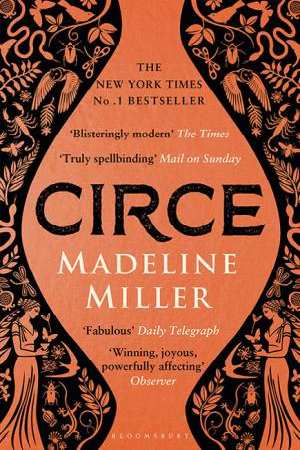
ImoReads… ‘Circe’ (2018) by Madeline Miller

Blog 7

“Humbling women seems to me a chief pastime of poets. As if there can be no story unless we crawl and creep”

DISCLAIMER: please read my blog on The Odyssey before reading this one 🙂

Alongside Emily Wilson, Madeline Miller is another female author who must be praised for her sensationally modern twist on Homer’s The Odyssey. Her novel centres on the life of nymph and sorceress Circe, who is dealt with in but a few lines in Homer’s work.

From the start, it is clear that despite being a goddess, Circe’s life is not luxurious and languorous. Nymphs are the lowest of the gods and their function is fundamentally to be married off to strengthen the power of their family; ‘in our language, it [nymph] means not just goddess but bride’. She is deemed unattractive, uninspiring and just downright strange by her father Helios and her mother Perse, so they are cruel to her and pretty much completely dismiss her. A dalliance with a mortal fisherman, Glaucos, sets Circe’s story in motion. Her efforts to turn him into a god despite not having the divine powers of her father reveal that she is a witch; she successfully uses pharmaka (sorcery) for the first time to change him. With his newfound powers, Glaucos scorns her without a second glance in favour of beautiful sea nymph Scylla. In a fit of jealousy and hurt, Circe uses pharmaka once more to turn Scylla into a hideous sea monster (that Odysseus will later encounter), and it is for this that she is banished to the island of Aiaia for all eternity. And yet, the story does not end here; this is where it begins. Miller has brought Circe to life as the woman who will not be silenced or caged as Zeus and her father desire.

Sadly, as Homer passes over Odysseus’ encounter with Circe so briefly, there is little even Emily Wilson could do to give her character more depth. In The Odyssey, she is simply an unpredictable, lonely witch who turns all men that come to her island into swine and of course, Odysseus is the one who can seduce her and keep his crew from this fate. Miller has given their relationship the airtime it deserves, as Odysseus stays on Aiaia for months (despite being ‘desperate’ to return home to his wife and son). I enjoyed the fact that in Miller’s modern re-telling, unsurprisingly Odysseus is not the be all and end all of charm and seduction. Circe has several lovers over the course of the novel, and each time it is her choice, and often by her own initiation. Furthermore, we learn that her tradition so to speak of turning men to pigs is a defence mechanism after she was once brutally raped by the captain of a passing crew. In the patriarchal (and dare I say misogynistic) society of Ancient Greece, it is likely that the concept of rape did not exist in the eyes of most men; Circe’s experience starkly demonstrates its everyday occurrence. 

Aside from her relationship with Odysseus, Miller shows us how Circe plays a role in many famed Greek myths, so if you want a round trip of the greats, this book is for you. For example, as a child she was the only one in her father’s court to show kindness to Prometheus during his first round of punishment. When her sister Pasiphae spawns the minotaur, it is down to Circe to create a spell to temper it while Daedalus builds the labyrinth to imprison it in. Indeed, her role in Scylla-gate (which has many versions) led to the creation of one of the most legendary monsters in Greek myth. An invisible player she may sometimes be, but she is undoubtedly a very important one. Bringing her to life as Miller has done as ‘the good witch’ is revolutionary in the sense that it starts eroding the idea that all the greats of Greek myth are male. 

On a technical level, I was extremely impressed by the language of the novel. Evocations of antiquity through Miller’s tone, vocabulary and writing style are faultless; I felt like I was reading a text written in the same year as The Odyssey despite its unwaveringly modern take on Circe’s story. The level of detail and knowledge weaved seamlessly into the story (as if it was created on Daedalus’ loom no less) is a credit to Miller and her research. 

Circe is a story that will dazzle your imagination with the big guns of Greek mythology and the world of the Ancient Greek Empire. This is reason enough to give it a read, but it is Circe herself that will leave the most enduring impression upon you. Her trials and tribulations are somehow both ancient and modern, relatable and godlike, optimistic and harrowing; they undeniably show that yes, she does matter, no, she will not be kept down and that yes, she is more than what she was designated to be by men such as Homer and Ovid.

Happy reading,

Imo x

Categories
Antiquity

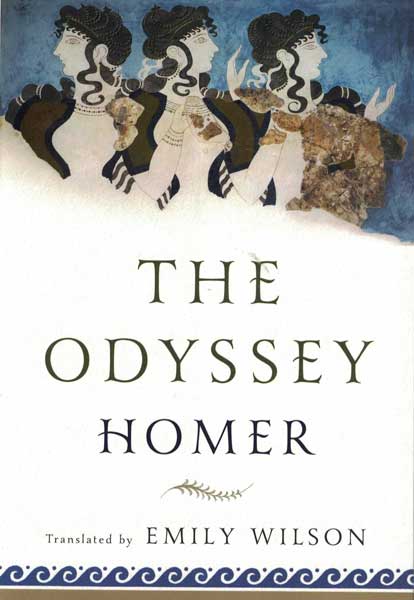
ImoReads… ‘The Odyssey’ (c.700BC) by Homer, translated by Emily Wilson

Blog 3

“The gods sat down for council, with the great

Thunderlord Zeus. Athena was concerned

about Odysseus’ many troubles,

trapped by the nymph Calypso in her house.”

The Guardian  culture writer Charlotte Higgins calls Emily Wilson’s translation of Homer’s The Odyssey ‘a cultural landmark’ and believes it will ‘change the way the poem is read in English’. I have to agree with her wholeheartedly on this point.

This epic poem, one of the longest in recorded history, has been translated many times including over 60 attempts into English. And yet, Wilson’s version is the first to be done by a woman. I feel privileged that this is the first version I got to read; I thoroughly enjoyed it and found it enchanting on so many levels. 

The Odyssey tells the story of Odysseus’ decade-long struggle to return home to Ithaca after the Trojan War. En route he faces the wrath of many gods and faces off against mythical creatures such as sirens and cyclops. All the while his wife Penelope and son Telemachus are in a constant state of anxiety trying to ward off the mass of suitors vying for Odysseus’ title, home, riches and wife. The poem ends with Odysseus’ return and glorious fight to take back Ithaca from the suitors.

Wilson somehow manages to style the language as crisp and comprehensible whilst also still evoking a captivating sense of antiquity. I think one of the key earmarks of this is the use of epithets. Some of my favourite character examples are ‘sharp-eyed Athena’ and ‘crafty Odysseus’. These would not be common terms to describe someone today, and yet they are still perfectly understandable. Furthermore, the island of Pylos is always described as ‘sandy Pylos’, and the goddess Athena is always pouring ‘sweet sleep’ onto the eyes of the mortal characters. There is no opulence in Wilson’s epic voice; these are just simple adjectives, and yet they accentuate that memorable, rhythmic quality of the ancient bardic tradition of oral poetry that Homer used as inspiration for The Odyssey.

I love also that Wilson has chosen to write in the English epic metre of iambic pentameter. Immediately I was drawn in by the enchanting, methodical rhythm of the poem; it somehow makes you feel as if you are watching the events unfold first-hand but also like you are hearing a song about a tale that happened a long time ago.

Although I am glad this is the first version I have read, I feel I do it a slight disservice by having not read any of the previous male-translated versions, because it is harder for me to appreciate how Wilson overcomes certain masculine conventions. For example, as I read it, one of Odysseus’ key characteristics that I picked up on was his duplicity. He is a hero nonetheless, but he has a talent for cunning and self-preservation. He is the only member of his crew to return to Ithaca alive and according to Higgins, Wilson’s translation that ‘he failed to keep them safe’ is the truest translation of the ancient Greek. She compares this to two male versions which translate this line as ‘he could not save them from disaster’ and ‘but so their fates he could not overcome’. Wilson does not let Odysseus off the hook quite so easily and reveals him for what he is.

So, one of my upcoming assignments will be to read a different version of The Odyssey to compare it to this one. However, I know I will be hard-pressed to find one better than Wilson’s. I would absolutely recommend this work if you want an enchanting introduction to the myths and legends of Ancient Greece; it is as riveting as it is prestigious. Next on my list of ancient classics? Homer’s The Iliad and Ovid’s Metamorphoses (Emily Wilson if you’re reading, please gift us with translations of these too…)

Happy reading,

Imo x